Mind, Body, and Spirit
Most martial arts focus just on physical training of the body, whereas in Bujutsu physical training is designed to develop the mind’s ability to perceive and the spirit’s ability to persevere.
Slow is smooth and smooth is fast.
We believe that the techniques of traditional Bujutsu are the most effective techniques for real combat situations, but it is also the training methods which produce high level skills. In the beginning stages of training at the Kochō Dōjō the students emphasize unarmed combat skills. The method of training has a different emphasis than most other martial arts. Instead of learning techniques in repetitive forms (katas) that are practiced in the air, the students of the Kochō Dōjō practice techniques on training partners in order to get the real hands-on experience needed to use the techniques in real combat.
The range of martial skills in the old Bujutsu is also more complete than most other martial arts. In addition to the many striking skills that most martial arts have, the curriculum at the Kochō Dōjō also includes a lot of evasive maneuvering, joint locks and grappling, tripping, throwing, pressure point manipulation, restraints, etc. The only way to gain skill in this knowledge is through hands-on training with partners, and it is this emphasis on realistic training that helps the Bujinkan maintain its practicality in today’s world.
The training starts off slow and easy, which is actually the fastest way to learn. Students are allowed to progress at their own rate, and techniques are gradually more complex in nature and are gradually practiced with greater speed so that control is developed to be able to practice even the most dangerous techniques in a safe manner.
Unarmed combat is the fundamental of all combat
Students first learn unarmed combat, because the common aspect of all combat including weapons is the human body. Before learning weapons a student must first learn to move their body. The body motion is the same, but weapons add technical complexities. So too the body motion of “unarmed” combat must work in situations when one is attacked with weapons. In a way, unarmed and armed combat are two side of the same coin.
Weapons
In addition to unarmed combat, students learn to use a variety of weapons. Weapons skills are important to gain deeper insights into the principles that make up our system, and they challenge the student in different ways. For example, different sizes of weapons affect the natural range of combat, and it is only through using weapons that students gain an understanding of how techniques are used to gain an advantage with a weapon or how to overcome the obstacles created by an opponent’s weapons. These new insights are directly applicable to unarmed combat, so that unarmed and armed training are complimentary aspects of an overall training method in warrior arts. This point is important: if a martial art does not work well against attacks with weapons, it doesn’t work.
Weapons are a natural part of combat, and it would be grossly negligent to ignore or take lightly the study of weapons. While it is bad enough to be attacked by an unarmed attacker, an attack with a weapon can quickly become fatal, so students must learn how to defend against attacks with weapons. Students are taught weapon skills as an integral part of their training from the beginning level, but the more complex weapons are emphasized after a certain level of competence with unarmed skills has been achieved.
The initial training with weapons focuses primarily on practical weapons that are more likely to be encountered, but advanced students also learn weapons that might seem a less likely threat, such as swords, spears, and halberds. However, the approach taken is to learn weapons as weapons shapes which can be improvised with whatever is at hand. For example, if attacked with a bat, a student might pick up a long pole and use it as a spear, or pickup a branch and use it as sword, or improvise a flashlight in a jutte technique. In this way one learns to use anything as a weapon, taking away the advantage an attacker tries to gain by using weapons.
Some of the weapons that are very common are knives, short stick, and short chain. Knives are amongst man’s earliest tools, and not only are they very common but they are easy to carry. A hanbo (3 foot stick) technique is easily used to defend oneself using an umbrella, and a kusari fundo (short chain) technique can be done with one’s belt. These weapons were important in the Age of the Samurai, and they are very useful in modern self-defense.
It is also important to know how to use a given weapon in order to know how to defend against it. A person who knows nothing about using a knife is easily intimidated by a knife-wielding attacker, and can loose an encounter before it starts by getting ‘psyched out’. By learning the wide range of weapons taught in Bujutsu, it is possible to understand the attacks of any weapon and so never be caught off guard.
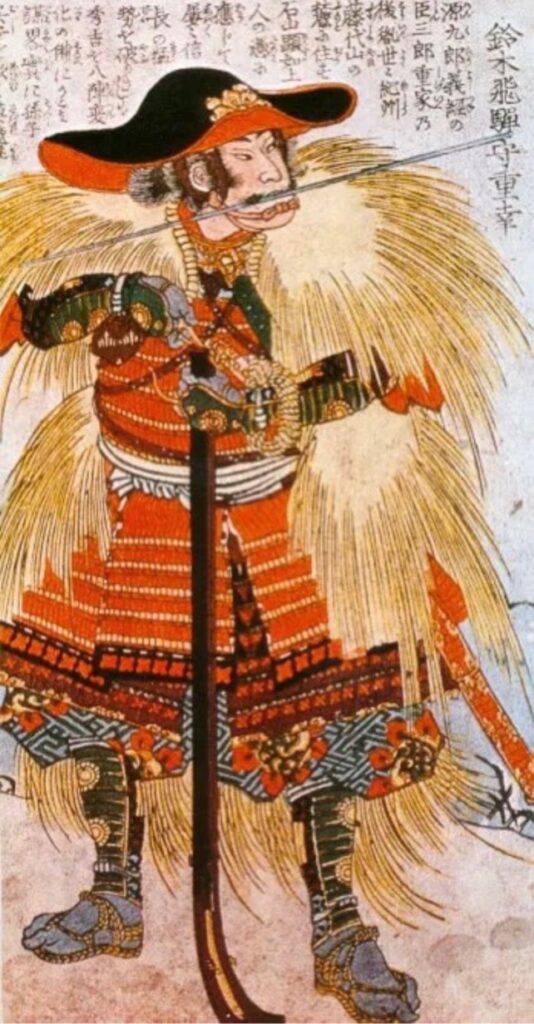
Guns are included in the skills of the Kochō Dōjō. One normally thinks of the gun as an American weapon, but in fact the warriors of Japan used guns to wage wars for half a century before the pilgrims landed on Plymouth Rock. Guns were one of the principle weapons that helped to unify Japan, making it a ‘nation of the gun’ when the United States was inhabited only by Native American Indians.
Some of the weapons used in training at the Kochō Dōjō are:
- Yawara & Tanbō – small sticks
- Hanbō – 3 Foot Stick
- Tantō – Knives
- Kusari Fundō – Weighted Chain
- Bō and Jō – 6 & 5 Foot Staff
- Katana – Swords
- Jutte – ‘Sword Catcher’
- Shuriken – Throwing Stars
- Yari – spears
- Naginata – halberds
- Teppō – guns
There are many other skills, but this gives an idea of what the training is like at the Kochō Dōjō. We consider these arts to be treasures passed down from the warriors of old and our dedicated training is our expression of gratitude for these cherished traditions.