War and Peace
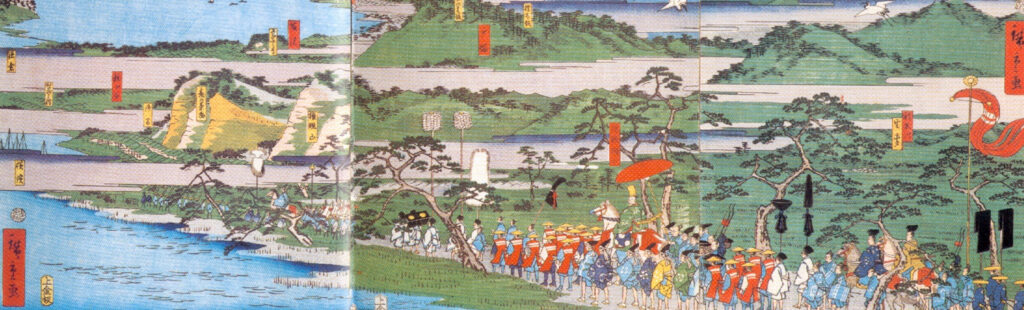
During Japan’s era of constant warfare the Bujutsu arts were perfected on the battlefields. During the era of peace the Budō were created for basic self-defense and sport.
The Martial Arts of Japan
Japanese martial arts are divided into two main categories:
Bujutsu: old warrior arts devised by Bushi, the professional warriors (samurai and ninja) for use on the battlefield, i.e. Jūjutsu, Kenjutsu, Bōjutsu, etc.
Budō: modern martial arts (created since the Meiji period) that are watered-down versions of older warrior arts devised for practice by commoners for basic self-defense or sport, i.e. Jūdō (from the older Jūjutsu), Kendō (from the older Kenjutsu), Aikidō (from the older Aikijūjutsu), Karatedō (from older Chinese arts), etc. The Budō were developed over the last 150 years.
The advantage of the Budō martial arts is that they are much simpler and easier to learn, making them good for the person who wants just some basic self-defense skills but doesn’t have the desire to master the warrior’s way. The Budō usually have one specific emphasis : Karatedō is primarily striking, Judō is primarily throwing, Aikidō is primarily passive grappling, etc., and many Budō have a strong sport aspect, which is very artificial and unlike actual combat. These aspects have made the Budō very popular around the world.
The advantage of the Bujutsu warrior arts is that they are more comprehensive, containing many techniques in all categories: striking, throwing, grappling, pressure point manipulation, restraints, etc., and include a vast array of weaponry skills including staffs, knives, swords, spears, halberds, guns, etc. The Bujutsu have no sport aspect (under the theory that sports create bad habits by limiting participants to “safe” movements), and are more difficult to learn because they usually include a greater volume of information, but the higher level of skill developed as an end result, and the emphasis of the spiritual/philosophical aspects are what motivates Bujutsu practitioners.
Bujutsu
The Samurai were the conventional forces of old Japan, analogous to the knights of medieval Europe, similarly relying upon armor, horses and the power of the sword. The Ninja were the spies and commandos of old Japan analogous to the modern CIA and Special Forces. Due to their fewer numbers, the Ninja relied on information gathering skills and surgical strikes to key targets at opportune times. As a unique combination of Samurai and Ninja skills, the Kochō Dōjō teaches the finest of Japan’s warrior skills. The curriculum includes these warrior traditions:
Kuki Shinden ryū
Takagi Yōshin ryū
Shinden Fudō ryū
Kotō ryū
Gyokko ryū
Togakure ryū
Real combat involves a flow of energy between two (or more) people, and solo katas do not effectively develop the skills necessary to manipulate that energy or a human body. At the Kochō Dōjō, techniques are practiced on real people to develop practical “hands on” experience. Budō training is easier, less hand-on, and combined with the trophies won through ego-building competitions, will certainly always be more popular with the masses. However intelligent people will be able to see that the more effective skills, insights, and knowledge of the Bujutsu are well worth developing, even though these real warrior skills require more time and effort to develop.
Each individual has slightly different reasons for training at the Kochō Dōjō, but a general goal might be as follows: Through enduring the hardships of warrior training and developing real skills in handling life-and-death situations, practitioners develop self-confidence that erodes self-doubt, anxiety, and fear, and which strengthens the spirit and empowers the mind to succeed in any of life’s goals, permitting the attainment and unguarded expression of genuine joy. Combat training becomes the vehicle through which students learn to develop the qualities that many philosophies and religions advocate but which lack a realistic method for developing.